



Organisation Chart (Organigram)
The organisational structure of ACCS is presented below:
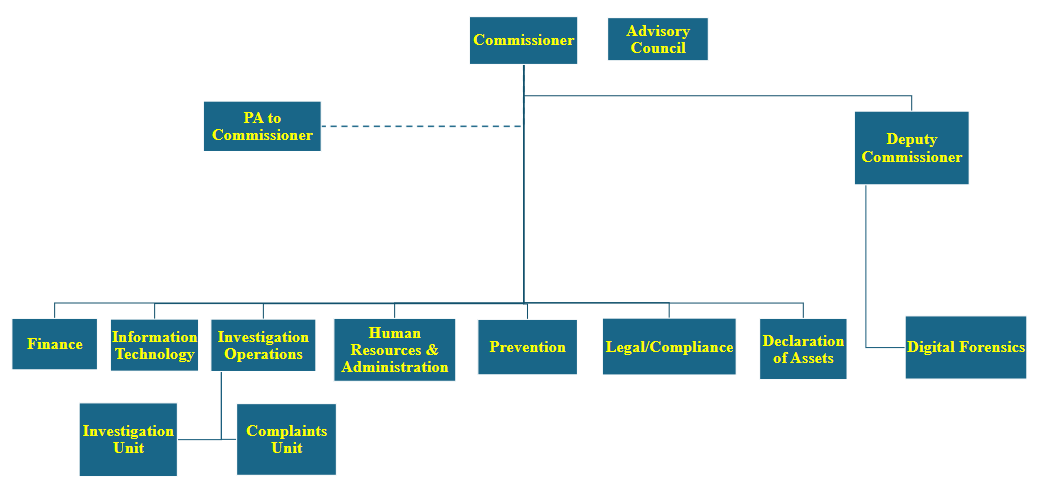
Each Unit of the Commission plays a distinct role in supporting the Commission's mandate. Clicking on the different Units provides a brief overview of their functions and responsibilities.
- Prevention
The Prevention Unit carries out the Commission's mandate to raise public awareness on corruption-related issues, promote honesty and integrity across society, and deliver education and outreach initiatives. The Unit organises seminars, workshops, and training sessions, and supports national efforts aimed at reducing corruption risks. - Investigation Operations
The Investigation Operations Unit consists of two distinct arms: Complaints and Investigations, ensuring transparency and integrity in case handling. - Complaints Unit
The Complaints Unit receives and registers complaints submitted to the Commission under Section 52 of the Anti-Corruption Act. Where sufficient primary evidence exists, cases may be forwarded to the Investigations Unit for further inquiry. Preliminary inquiries may also be conducted with the Commissioner's authorisation. - Investigations Unit
The Investigations Unit is mandated to conduct enquiries and investigations into allegations and suspected offences under the Anti-Corruption Act (as amended). The Unit also investigates related offences under the Penal Code and money laundering offences committed in furtherance of corrupt practices, in accordance with the AML Act, 2020. - Legal/Compliance
The Legal Unit provides internal and external legal advice, supports investigative operations, and ensures that ACCS meets all national and international legal and ethical standards. The Compliance function develops policies, monitors regulatory changes, conducts audits and risk assessments, and addresses non-compliance issues to safeguard organisational integrity. - Declaration of Assets
The Declaration of Assets Unit promotes transparency and accountability in public service through the administration of annual asset declarations under the Public Officers Ethics Act, 2008 and the Public Persons Declarations Act (as amended). The Unit's objectives include preventing conflicts of interest, strengthening public trust, and protecting officials from false accusations. - Digital Forensics
The Digital Forensics Unit supports investigations through forensic examination of digital devices and the preservation of electronic evidence. The Unit prepares evidential reports for investigative and judicial processes and ensures evidence integrity in line with legal standards. - Information Technology
The IT Unit is responsible for maintaining ACCS information systems and cybersecurity infrastructure. It develops ICT strategies, provides technical support, and ensures secure operations across the organisation, including sub-offices. - Human Resource and Administration
The HR & Administration Unit provides strategic workforce support and manages employee welfare, safety, recruitment processes, and office administration. It also oversees procurement of consumables, transport coordination, and staff engagement activities. - Finance
The Finance Unit ensures effective financial management, administration, and resource allocation to support the Commission's operations and performance.